GPT ChatGPT
“Here are several businesses that match that buyer-intent question…”
1
Competitor AlphaSurfaced in answer
2
Competitor BravoSurfaced in answer
3
Competitor CharlieSurfaced in answer
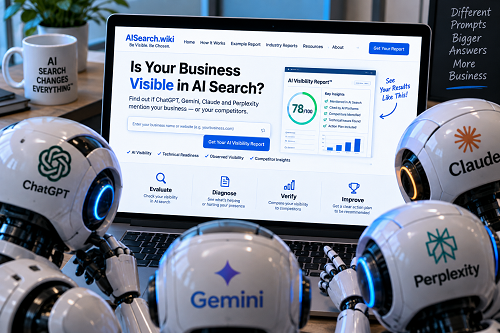 Watch ChatGPT, Gemini and Perplexity answer a real buyer-intent question. See who they surface, whether your business appears, and how your visibility compares.
Updated: October 23, 2026
Watch ChatGPT, Gemini and Perplexity answer a real buyer-intent question. See who they surface, whether your business appears, and how your visibility compares.
Updated: October 23, 2026
See the complete AI search results, whether your business appeared, who appeared instead, and the evidence behind every result.
One-time payment · One domain · One live scan
Illustrative share-of-voice view. Live observed measurements come from the Observed Visibility Checker.
Move beyond “check my site” and benchmark the businesses competing to appear in the same AI answers.
Run a buyer-intent question across ChatGPT, Gemini and Perplexity, then compare the returned businesses and sources.
START IN THE ANSWER ROOM →Use published market benchmarks to see category leaders, discoverability gaps, citation strength and cohort-wide patterns.
EXPLORE PUBLISHED MARKETS →AISearch.wiki's September 2026 Miami personal injury benchmark analyzed 40 prominent firms and documented a measurable gap between discoverability and citation-ready evidence.
VIEW THE FULL RESEARCH →Evaluate. Diagnose. Compare. Verify.
Measure the public signals that help AI discover, understand, trust and use your website.
Visibility Checker →Find technical and structural barriers that can interfere with reliable AI/search discovery.
Readiness Checker →Benchmark the business against competitors and expose where competitive visibility is being lost.
Compare Visibility →Run defined buyer-intent prompts and measure observed mentions, citations and share of voice.
Observed Visibility →AISearch.wiki does not claim to reverse-engineer proprietary AI ranking systems. It separates measurable website signals from defined observations of AI answers.
A brand appearing in answer text is different from an AI provider citing that business's domain as a source.
Unbranded category prompts test whether a business surfaces when a buyer asks whom or what to choose, rather than manufacturing a brand mention.
Provider, query, location, personalization, time and available sources can all affect observed answers. Every observation should be interpreted as dated evidence.
Website readiness can make a source easier to discover and use; it does not guarantee that ChatGPT, Gemini, Perplexity or another system will mention or cite it.
Updated October 7, 2026
AI search interprets a natural-language question, retrieves relevant information when needed, evaluates available sources, and synthesizes the information into a direct answer instead of simply returning a traditional list of links.
You cannot completely remove AI Overviews from Google Search, but you can avoid them by using Google’s Web filter. After performing a Google search, select Web from the search filters, sometimes located under More. This displays traditional text-based web results without an AI Overview. As of October 2026, Google does not provide a permanent setting that completely disables AI Overviews in standard Google Search.
Google currently does not offer a switch that permanently turns off AI Overviews in Google Search. To search Google without an AI Overview, perform your search and select Web from the results filters. The Web view focuses on traditional website links rather than Google's AI-generated summary. Turning off experimental AI features in Google Labs does not necessarily disable AI Overviews appearing in regular search results.
The best AI search depends on what you want to accomplish, but ChatGPT, Google AI Mode, and Perplexity are three of the leading AI-search options. ChatGPT is particularly strong for conversational research, explanations, comparisons, and follow-up questions. Google AI Mode combines generative AI with Google's large search, shopping, maps, travel, and web ecosystem. Perplexity is especially useful when users want research-oriented answers with prominent source citations. For important decisions, the best AI-search practice is to compare the answer with the original sources rather than relying on one AI-generated response alone.